Soil is the foundation of agricultural production in both literal and economic terms. It determines yield potential, forms nutrient availability, accumulates or loses moisture, regulates microbiological processes, and directly affects the financial model of every agricultural enterprise. In modern conditions, soil has ceased to be just a natural resource—it has become an asset that requires management, investment, and strategic planning.
Ukraine historically possesses a unique soil fund, however, intensive farming, climate change, and organic matter imbalance are gradually changing the properties of even the most fertile soils. As a result, the main challenge becomes not only obtaining yields but also preserving the soil’s potential as the economic foundation of agribusiness.
Soil as a Living System and Economic Resource

From a scientific perspective, soil is not an inert mass. It’s a complex living system where physical, chemical, and biological processes occur simultaneously. It functions as an environment for plant root systems, a nutrient reservoir, a water filter, and a habitat for microorganisms. Each of these functions has a direct impact on production economics.
Soil forms the primary level of crop productivity even before any fertilizers or protective agents are applied. The higher the soil’s basic potential, the lower the cost of achieving planned yields. Conversely, degraded soil forces farmers to compensate for losses through increased spending on nutrition, cultivation, and protection, which reduces profitability.
Types of Ukrainian Soils and Their Agro-economic Significance
Ukrainian soils are characterized by significant diversity: from soddy-podzolic soils in northern regions to dark chestnut soils in the steppe zone. However, chernozems remain the foundation of agricultural production, providing high natural fertility due to significant humus content, optimal structure, and high nutrient absorption capacity.
The economic advantage of such soils lies in their ability to consistently form yields even with minimal fertilizer application compared to poorer soils. However, even chernozems are not an inexhaustible resource. Reduction in humus content by fractions of a percent across hundreds of hectares translates into the loss of tons of potential yield and millions of hryvnias in unrealized income.
Humus as a Key Indicator of Soil Economic Health

Humus determines most agronomically important soil properties: structure, moisture capacity, ability to retain nutrients, and microflora activity. It’s the main indicator of long-term fertility. At the beginning of active chernozem involvement in industrial agriculture, humus content in many regions exceeded 6-7%. Today, in a significant portion of lands, this indicator has decreased to 3-4%, and in some places even lower.
From an economic perspective, every 0.1% of lost humus means increased need for mineral nutrition, poorer moisture utilization, and reduced crop resistance to stress conditions. Humus restoration is an extremely slow process that requires decades even with systematic organic matter application.
Soil Structure and Its Impact on Yield and Costs
Soil structure determines the ratio of solid aggregates, pores, and water. It forms conditions for root penetration, air and water movement. Soil compaction, destruction of crumb structure, and topsoil crusting lead to a sharp decrease in moisture and nutrient use efficiency.
Compacted soil impairs seed germination, reduces crop growth rates, and increases drought risks even with sufficient rainfall. In financial terms, this means increased costs for reseeding, additional cultivation, increased fertilizer application, and ultimately, decreased profitability.
Soil Water Balance as a Strategic Yield Factor
Water in soil is a limited resource that determines the efficiency of photosynthesis, transpiration, and yield formation. Climate change has made moisture conservation a key issue for most regions of Ukraine. Even with an overall increase in precipitation, its distribution over time becomes uneven, enhancing the soil’s role as a water accumulator.
Soils with high humus content and well-formed structure can retain moisture much more effectively. This reduces yield dependence on short-term droughts and minimizes the need for compensatory measures. From an economic perspective, this means more stable yields and lower costs for stress-resistant technologies.
Soil Degradation as a Hidden Financial Risk
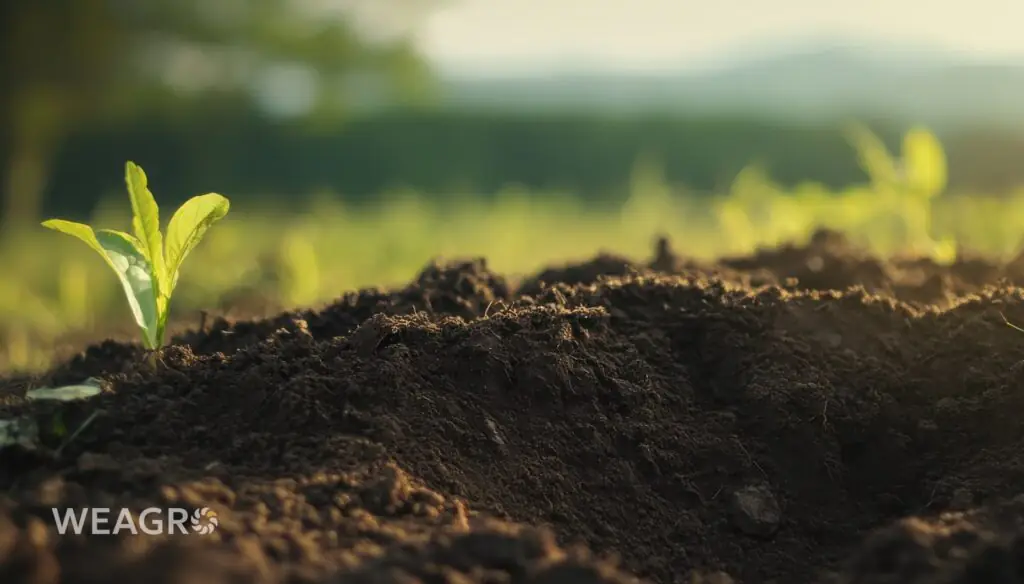
Soil degradation rarely has an immediate effect, but it’s always cumulative. Loss of structure, decrease in humus, erosion, salinization, and acidification gradually reduce productivity without sharp drops, making the problem less noticeable over short periods. However, over a 5-10 year horizon, degradation can destroy the economics of even a highly profitable farm.
Water and wind erosion are particularly dangerous, not only removing the fertile layer but also carrying away nutrients that have already been invested in. Essentially, each soil washout is a direct loss of investments in fertilizers and technologies. In financial terms, this means double losses: lost harvest and repeated costs for fertility restoration.
Economics of Soil Restoration
Soil restoration is much more expensive than preservation. Any remediation measures require long-term investments in organic matter, biological activity, acidity correction, and agrophysical properties. Returning humus even by 0.5% can require decades of systematic organic matter application.
Therefore, from an economic perspective, the most profitable strategy is not restoration but preventing degradation. Investments in crop rotation, green manures, organic fertilizers, and minimizing mechanical impact on soil provide a slow but stable effect, which ultimately yields much higher returns than emergency measures after fertility loss.
Soil and Farm Financial Model
Soil directly shapes the enterprise’s financial model. High natural fertility reduces dependence on expensive resources, making production less capital-intensive. Conversely, degraded soil increases the need for external financing, increases credit load, and reduces financial stability.
For farms operating within strict financial constraints, soil condition often determines the possibility or impossibility of profitable activity. That’s why managing soil potential should be part of financial strategy, not just agronomic planning.
In this context, the ability to form a system of nutrition and soil protection without peak pressure on working capital becomes particularly important. This is exactly how WEAGRO’s online service native agricultural installment works, allowing agribusiness to plan soil investments during the off-season without blocking liquidity during the most vulnerable periods.

Soil as a Long-term Investment Asset
From an agricultural economics perspective, soil is an asset with the longest investment cycle. It cannot be quickly “purchased,” promptly restored, or completely replaced by technologies. Every decision regarding cultivation, nutrition, crop rotation, and mechanical load accumulates in soil properties over years.
Farms that view soil as a strategic asset build a completely different development model. They focus on stability, predictability, and capital protection rather than one-time maximum profit. This approach allows maintaining competitiveness in the long term.
Management Dimension of Farm Soil Policy
Soil management policy is an indicator of management quality. It reflects planning horizons, level of strategic thinking, and ability to balance between today’s profit and tomorrow’s stability. Agricultural enterprises that consciously invest in soils typically demonstrate higher levels of financial discipline, predictable cash flows, and more sustainable profitability indicators.
Meanwhile, ignoring the soil factor sooner or later leads to a situation where even with high product prices, the enterprise cannot achieve desired financial results due to degradation of the basic resource.
Conclusion
Soils are not just the natural basis of agricultural production but a strategic economic asset. Yield, cost, liquidity, and long-term financial stability of agribusiness depend on their condition. In modern conditions of climate change and rising costs, preserving soil potential transitions into the realm of enterprise financial security. Farms that invest in soil systematically receive not only yields but also stability, predictability, and opportunity for future development.