Vertical farming was perceived as an experiment or niche solution for urban agriculture just a few years ago. However, today this approach is gradually transitioning into the realm of applied agricultural economics, where the key factors are not loud innovative statements, but specific indicators of yield, production stability, and result predictability. One of the most illustrative examples of such transition is the case of Dyson Farming, where vertical strawberry growing systems have become a tool for systematic efficiency improvement.
This case is interesting not only from a technological perspective. It demonstrates how an engineering approach, environmental control, and rethinking of growing space can change the economics of a crop that is traditionally considered labor-intensive, weather-dependent, and subject to seasonal fluctuations.
Why Strawberries Became the Focus of Vertical Farming
Strawberries are one of the most sensitive crops to external factors. They react acutely to temperature fluctuations, humidity, solar radiation, soil quality, and biological pressure. That is why any instability in the environment immediately affects yield, berry quality, and production costs.
For traditional soil cultivation, this means a constant compromise between protection costs, risk of losses, and limited ability to control the process. Vertical farming fundamentally changes this logic. It does not try to “adapt” to nature, but creates a controlled environment where key parameters are under constant control.
In the case of Dyson Farming, strawberries became a demonstration crop on which engineering solutions could be tested, harvest logistics optimized, losses reduced, and stable quality achieved throughout the entire cycle.
The Essence of the Vertical Approach in Dyson Farming’s Implementation
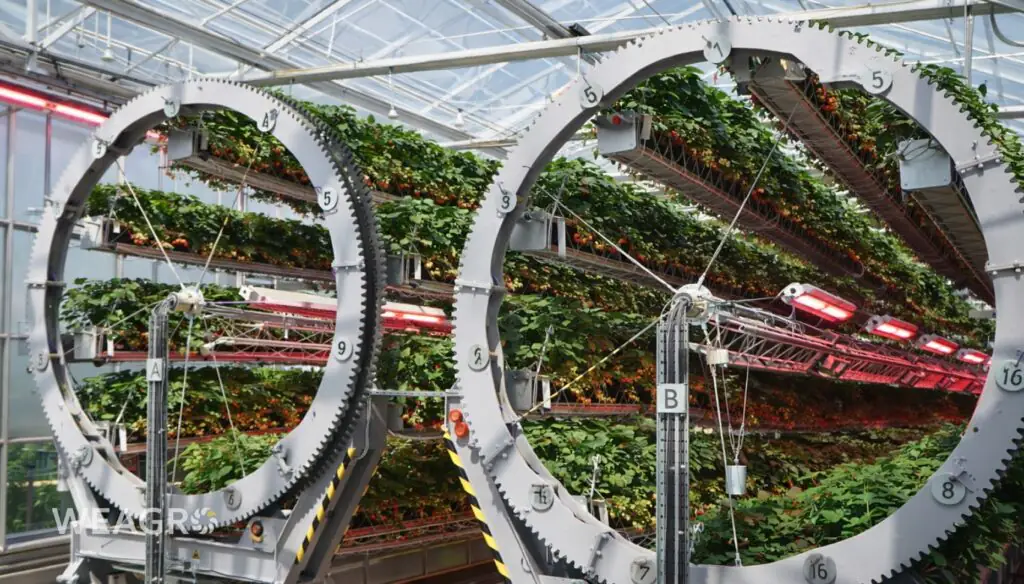
Vertical farming in this case is not limited to multi-tier plant placement. It involves a comprehensive system where space, light, air, water, and nutrition work as a unified mechanism.
Strawberries are grown in vertical structures inside specialized greenhouse complexes. Plants are placed not horizontally on the ground, but in vertical modules, which allows for a significant increase in planting density without reducing access to light and air. The lighting regime is formed using LED lighting with a precisely selected spectrum that stimulates photosynthesis and plant development during key growth phases.
Critically important is that all environmental parameters—temperature, humidity, nutrient supply—are not simply set, but constantly adjusted based on data. This reduces the human factor and allows working not “by feel,” but on measurable indicators.
How Vertical Farming Affects Yield
The main effect of the vertical approach is not a one-time increase in harvest, but result stability. Stability is precisely the key value for agribusiness that works with contracts, sales planning, and revenue forecasting.
In traditional strawberry cultivation, even minor weather deviations can reduce yield or deteriorate berry quality. Vertical farming eliminates this factor. The harvest is formed under conditions where there are no sharp temperature fluctuations, excessive precipitation, or light deficiency.
As a result, not only is there an increase in yield per unit area, but also an equalization of product quality. The berry has predictable size, shape, and taste characteristics, which directly affects its commercial value.

Economics of Vertical Cultivation: Where the Effect is Formed
At first glance, vertical farming appears capital-intensive. And this is indeed true: investments in structures, lighting, automation, and engineering systems are significant. However, the key question is not the cost of entry, but the structure of costs and revenues throughout the project’s life cycle.
In the case of Dyson Farming, the economic effect is formed through several factors. First, yield per unit area increases significantly, which reduces the conditional “land cost” in the cost structure. Second, losses from diseases and weather risks are reduced, which in classical agricultural production are often considered inevitable.
Third, the use of labor resources is optimized. Vertical systems facilitate access to plants, reduce physical load, and allow partial automation of harvesting and care processes. In the long term, this reduces dependence on seasonal labor shortages.

Quality Control and Product Safety
Another important aspect of vertical farming is quality control. In a closed environment, it is much easier to track the entire production chain—from water and nutrient supply to the moment of berry harvest. This reduces the need for aggressive protection measures and increases consumer confidence in the product.
For a market where traceability of origin and stable quality are increasingly important, this factor becomes a competitive advantage. That is why vertical cultivation is increasingly viewed not as “exotic,” but as a tool for working with premium market segments.
Is Vertical Farming a Universal Solution
Despite all the advantages, vertical farming is not a panacea for all crops and all farms. It requires a different approach to planning, finance, and risk management. The key difference is that here a significant portion of costs is transferred from the operational level to the capital level.
This means that the decision to implement vertical systems should be based not on trends, but on clear calculations of economics, sales market, and payback horizon. That is why the Dyson Farming case is interesting as an example of a systematic approach where technology is subordinated to business logic, not vice versa.
What This Case Means for Agribusiness Overall
Vertical farming as implemented by Dyson Farming demonstrates a broader trend: agribusiness is gradually moving from a reactive model to a controlled one. When a producer stops being hostage to weather and begins working with predictable parameters, the entire management philosophy changes.
For classical agribusiness, this does not mean the necessity of immediate transition to vertical systems. But it does mean that approaches to planning, environmental control, and data utilization become critically important. Even in open soil, more and more decisions are made taking into account analytics, scenario planning, and long-term economics.