When a farmer first hears about carbon credits, a simple question usually arises: who pays for this? In practice, buyers can be large international companies—from technology giants to airlines or food brands. For them, this is not charity, but part of their climate strategy and a tool for managing their own emissions.
Today, farmers most often do not search for buyers independently. If the project is led by an external developer, they typically handle the subsequent sale of credits. However, in my view, this is not permanent. The market is maturing, and farms themselves are maturing along with it. Some farmers already see their own carbon project not simply as an additional bonus, but as a separate opportunity for development. In such cases, the question “how to find your buyer?” becomes quite natural. This is what we will discuss today. But let us proceed in order.
Why Companies Buy Carbon Credits at All
Today, an increasing number of international companies are taking on climate commitments. They publicly announce emission reduction targets within Net Zero or Carbon Neutral strategies. For businesses, this is no longer simply a matter of reputation. A company’s climate policy increasingly determines access to investments, partnerships, and even certain markets.
Companies can reduce some emissions independently, for example by switching to renewable energy, changing production technologies, or optimizing logistics. However, eliminating all emissions is nearly impossible. Any business always has what is called a “residual” carbon footprint.
This is where carbon credits come in. By purchasing them, a company effectively finances a climate project that either reduces emissions or removes carbon from the atmosphere. This allows businesses to offset the portion of their own emissions that they cannot currently reduce through technological solutions.
In this context, agricultural projects become particularly attractive to buyers. Agriculture has one unique property: it can not only reduce emissions but also sequester carbon in the soil. This is why carbon credits from carbon farming are increasingly viewed as one of the promising tools in the climate strategies of large companies.

Why Carbon Farming Attracts Buyer Interest
The global market includes many types of carbon projects. These can be forestry programs, renewable energy projects, methane capture, or direct air capture technologies. Each of these areas plays a role in the climate transformation of the economy.
However, in recent years, agricultural projects related to soil management have attracted increasing attention. The reason is simple—scale. Agriculture occupies a vast portion of land, and soils are capable of storing significant amounts of organic carbon.
For companies, this means the potential for large-scale climate solutions. Changes in agricultural practices, such as reducing intensive tillage, using cover crops, or managing crop residues, can gradually increase carbon stocks in the soil. This effect becomes the basis for creating carbon credits within carbon farming.

There is another reason for interest in such projects. Unlike many technological solutions, agricultural practices often have additional positive effects: improved soil structure, increased fertility, better water retention capacity, and support for biodiversity. For large companies, this means that the climate effect is combined with broader ecosystem impacts.
This is why an increasing number of corporate climate programs are beginning to include agricultural projects in their portfolios. And sometimes this leads to very large deals in the carbon credit market.
Example of a Major Deal: Indigo Carbon and Microsoft
To understand the scale of interest in agricultural carbon credits, it is sufficient to look at real deals already taking place in the market.
One of the most illustrative examples is the collaboration between the American company Indigo Ag and Microsoft Corporation. Indigo Ag develops the Indigo Carbon program, which works with farmers to implement carbon farming practices and converts carbon sequestered in soil into carbon credits. Under this program, Microsoft agreed to purchase approximately 2.85 million carbon credits to be generated over the next 12 years. The total value of such a deal, according to market estimates, could range from $171 to $228 million, depending on the credit price, which in this case is estimated at approximately $60–80 per ton of CO₂e.
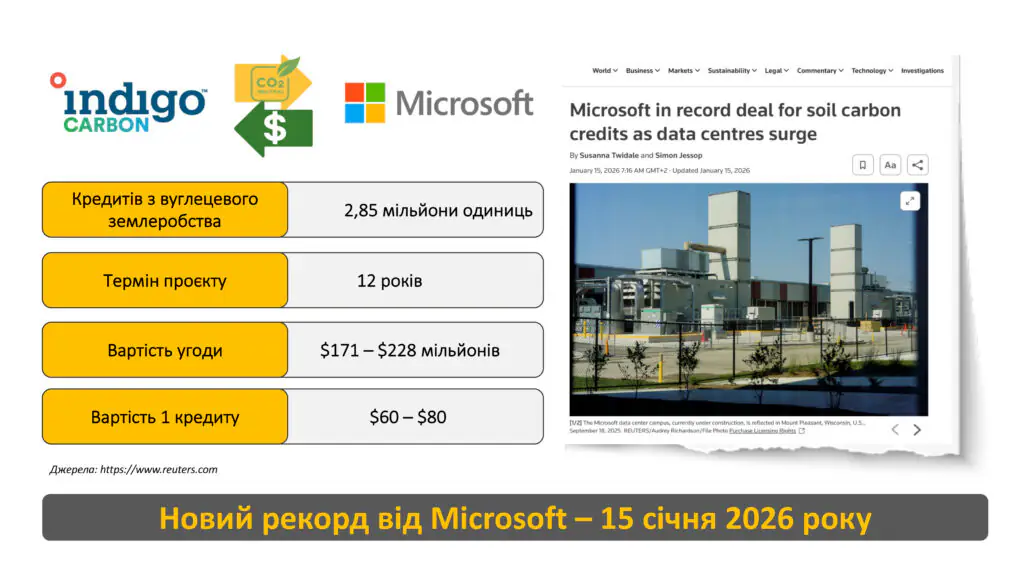
This example clearly demonstrates two important points. First, large international companies are already prepared to enter into long-term agreements with agricultural projects. Second, for them, it is not only the ton of CO₂ itself that matters, but also the quality of the project, data transparency, and confidence in the results.
This is why such credits are typically created within international verification standards that allow buyers to be confident in the credibility of the climate impact.
What Credits Do International Companies Actually Buy
There is one important point in the carbon credit market that is worth understanding. Not all credits are the same, and not all are equally accepted by international buyers.
Large companies typically focus on credits created within recognized international standards. Such systems define the rules for calculating climate impact, verification procedures, and data transparency requirements. The most well-known examples of such standards are Verra and Gold Standard.
The CORSIA mechanism deserves separate mention—an international system created to offset emissions in global aviation. Under this program, airlines can only use carbon credits that meet specified requirements and are recognized by this system.
From 2027, CORSIA transitions to a mandatory phase, and this could significantly affect the structure of market demand. It is expected that new rules will limit the use of credits from some forestry projects, while opening opportunities for other types of climate solutions. In particular, agricultural soil carbon sequestration projects that can generate credits under the Verra standard have already been included in the list of eligible approaches.

This is a very important signal for the market. Since the aviation industry is one of the largest potential buyers of carbon credits, demand for quality carbon farming credits is expected to increase noticeably. This, in turn, opens new opportunities for farmers working with such projects.
How Farmers Can Find Buyers Once a carbon project has been created and credits undergo verification, the next stage is their sale. In practice, there are several main models through which agricultural carbon credits reach buyers.

Direct Agreements with Companies
In some cases, large corporations enter into direct long-term contracts with developers or owners of carbon projects. Such agreements are often signed before credits are actually issued and can span several years ahead.
This model is more commonly found in large or well-structured projects. Its advantage lies in the ability to negotiate individual collaboration terms and potentially obtain a higher price per credit.
Sales Through Brokers
The most common path for most projects involves working through brokers or specialized intermediaries. They help find buyers, structure deals, and facilitate sales in the international market.
For farmers or project developers, this often means access to a wider range of buyers and better orientation in the market situation.
Trading Platforms
Another option involves using specialized trading platforms, or so-called carbon marketplaces. These are essentially online platforms where carbon credits are bought and sold between various market participants.
Examples of such platforms include Emsurge, CBL, and Xpansive. Such platforms are gradually forming the infrastructure for more open and transparent carbon credit trading.
What’s Next?
In the next column, we will examine the broader market picture: what major deals have already taken place globally, what investments are entering this sector, and why increasing attention is focused specifically on agricultural carbon credits. We will also discuss the direction in which this market may develop in the coming years and what opportunities this opens for farmers.
Together we are building a sustainable future for Ukraine’s agribusiness!