Ukrainian farming is gradually changing. And increasingly, it is no longer a story about “grow and sell,” but about something different—finding an idea that will attract attention even before the buyer looks at the price.
This is exactly how the “Berry Country” farm in the Chernihiv region operates. Here they experiment not only with yield or technologies but with the product itself. Sometimes—quite unexpectedly.
“We Wanted to Create Something Unusual”
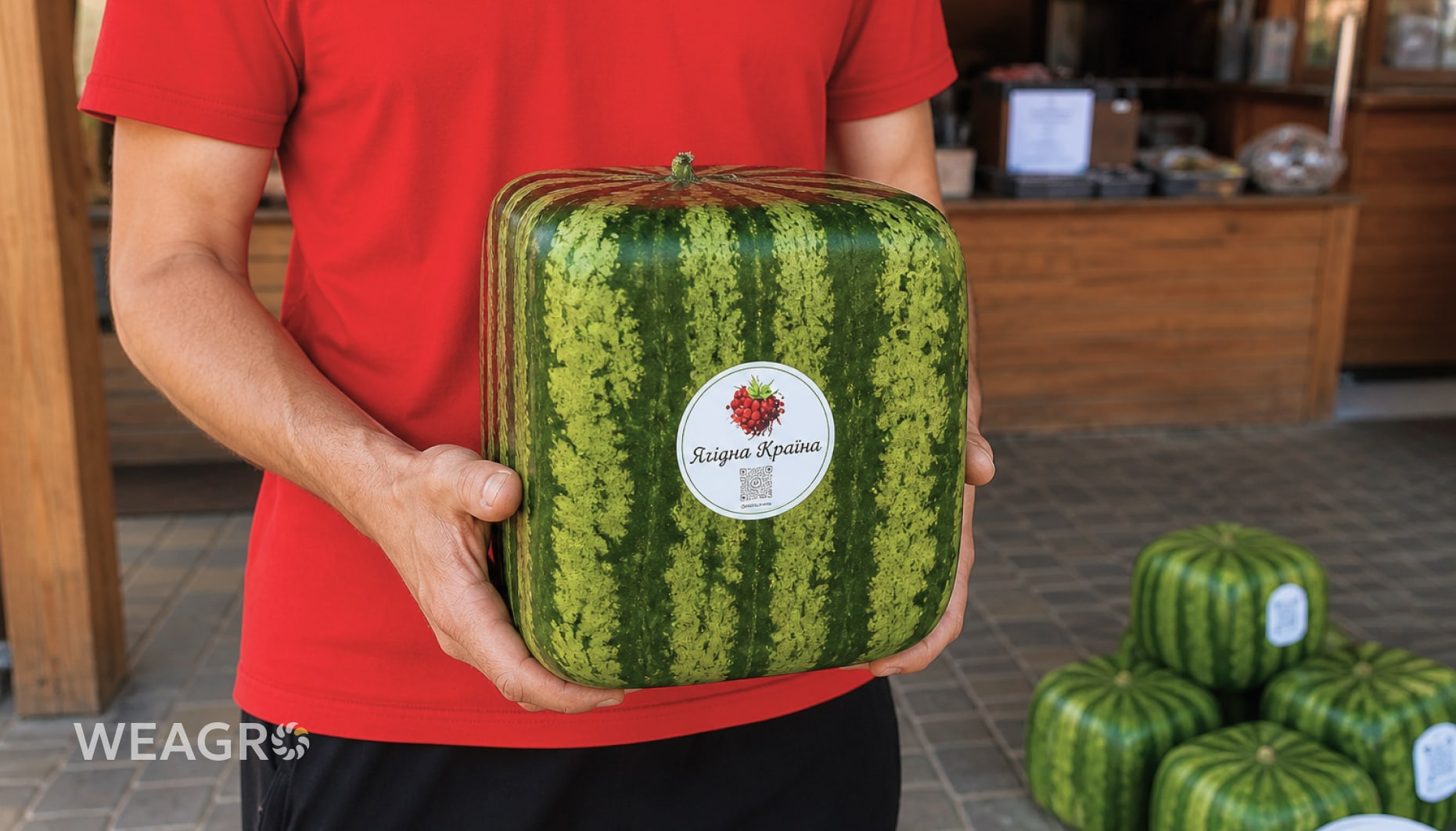
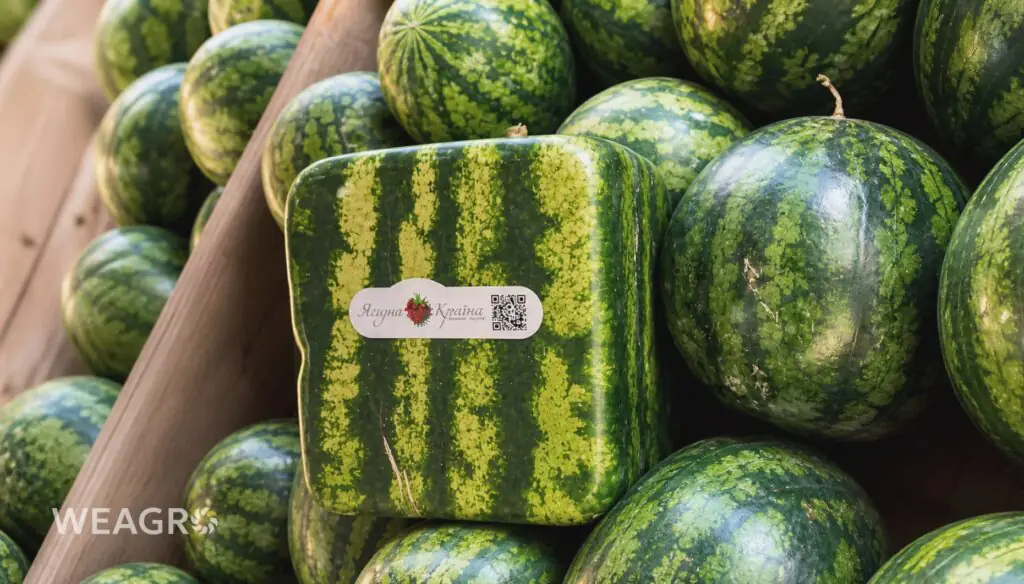
It all started with an idea that looks almost like a joke. Japanese square watermelons have long existed as a marketing product—they are purchased not for taste but for shape.
“We wanted to create something unusual—like Japanese square watermelons. So we decided to try growing such a watermelon ourselves. But, as it turned out, it is very difficult,” the farm reports.
This was not an attempt to change the market. This was an attempt to verify whether it is even possible under Ukrainian conditions.
A Watermelon Grown Not for Taste
The first results did not appear immediately. Not even after one season. Farmers worked with varieties for several years, selected technologies, and experimented with shapes. Ultimately, over two years, they managed to obtain only one result—and that was far from ideal.
“Only one watermelon succeeded for us in two years. And even that one turned out not square but cubic,” notes farm co-owner Serhiy Remenets.
The next season yielded six fruits. And even this became a result that attracted attention.
What the Process Looks Like—Something Almost No One Thinks About
A square watermelon is not a separate variety. It is a technology. It is grown in special molds into which the fruit is placed during growth. And here is where it gets most interesting: not every watermelon withstands the pressure, not every one grows evenly, not every one reaches the required shape.
“Three watermelons out of six are perfectly shaped, and some are not,” the farm explains.
In fact, each such fruit is the result of an experiment. And that is precisely why there cannot be many of them.
“If we make additional molds, there will be slightly more. Overall, we produce 10–15 such watermelons per season,” adds store manager Natalia Nikitina.

Why Do People Buy What Is “Not Better in Taste”
The most interesting part of this story is not the cultivation process itself but the market reaction. Such watermelons do not differ in taste. They have no agronomic advantage. Their value lies in their shape.
“The price for such watermelons is higher than usual, but people bought them. They taste ordinary, but the skin is different,” Natalia explains.
And this is where the shift in agribusiness logic becomes evident. The product sells not because it is better but because it is interesting.
From Experiment to Product
What began as an idea is gradually becoming a separate direction. The farm is already discussing scaling. Not abrupt, not massive—but stable.
“Next year there will be even more,” the farmers say.
Behind this phrase is not just enthusiasm. It is an understanding that demand exists. And that a product, even a niche one, can find its buyer.
Parallel Strategy—Playing on Seasonality
In addition to experiments with shape, “Berry Country” also works with another factor—timing. In May, the farm plans to enter the market with early strawberries. And this is a different strategy: not to surprise with shape but to enter the season earlier than others. The logic is simple: when a product appears first, it automatically becomes more valuable.
What This Story Actually Shows
The story of “Berry Country” is not about watermelons. It is about how the role of the farmer is changing. Today, this is not just a producer. This is a person who works with the product as an idea.
Modern agribusiness is a continuous cycle: attempt → error → result → scaling.
And it is precisely this cycle that creates competitive advantage.
An Idea Works When There Are Resources for Its Implementation
Any experiment is not only enthusiasm. It is also costs. Testing new solutions, searching for technologies, working with molds, additional resources—all of this requires flexibility in management.
That is why today more and more farmers are paying attention to tools that allow them not to postpone ideas but to implement them within the season.
The WEAGRO online service in this context helps agribusiness work differently: not wait until free funds appear but plan development ahead, work with verified suppliers, and move faster from experiment to stable production.
Farming That Creates Demand
Today, agribusiness is no longer just about harvest. It is about the ability to notice changes, test new approaches, and create a product that generates interest even before purchase. A square watermelon is not about shape. It is about approach. And it is precisely this approach that determines what agribusiness will be tomorrow.
Source: CHELine