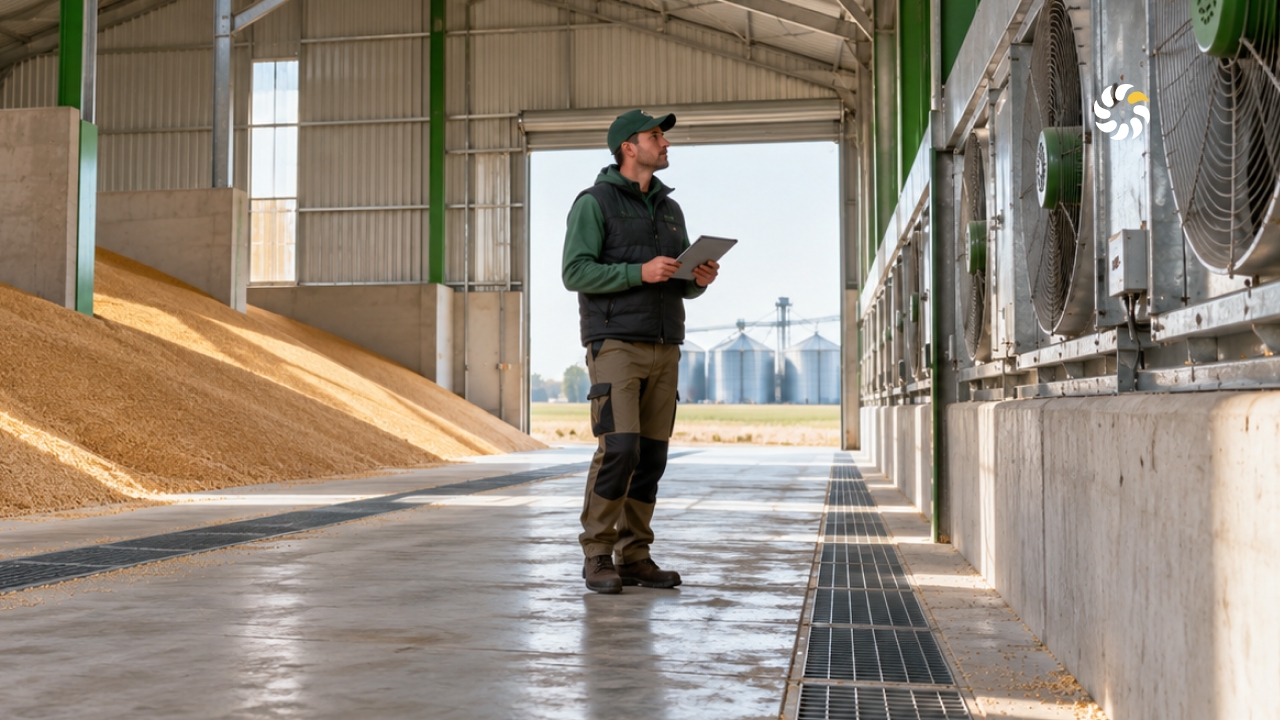
Preparing a warehouse for grain storage begins before the arrival of a new batch. Dust, residues from the previous harvest, leaks, clogged ventilation ducts, faulty sensors, or signs of pests create risks that are harder to eliminate after the facility is loaded. In winter, such deficiencies can lead to localized heating, moisture buildup, and deterioration of stock quality.
A practical plan includes auditing, cleaning, repairs, equipment testing, product assessment, and monitoring. Winter grain storage is planned separately for wheat, corn, sunflower, and rapeseed, taking into account the initial condition and duration.
Preparing a warehouse for grain storage: where to start the audit
First, record the actual state of the infrastructure. The inspection is conducted along a route that covers the premises, equipment, and the surrounding area. The checklist includes:
- roof, walls, floor, joints, cracks, gates, and doors;
- points of precipitation entry and condensation appearance;
- ventilation ducts and active ventilation systems;
- electrical grid, lighting, and backup power;
- transporters, bucket elevators, screw conveyors, and intake units;
- thermometry systems, sensors, and fire safety equipment;
- access roads, water drainage, vegetation, and debris around the facility.
Problems are divided into three groups: critical before loading, required before frost, and capital improvements. For each item, assign a responsible person, budget, and deadline.

Cleaning and sanitary preparation of the premises
After emptying the storage, remove grain, dust, debris, packaging, and batch residues. Separately clean joints, pits, ventilation ducts, bucket elevators, and transporters. Old material can support pest development.
The sequence of work is conveniently organized as follows:
- Clear the premises and equipment of residues.
- Perform dry mechanical cleaning of accessible surfaces.
- Disassemble and clean technological units according to instructions.
- Identify cracks, wet zones, and infestation hotspots.
- Perform repairs and sealing.
- Carry out planned sanitary measures.
- Re-inspect the warehouse before intake.
Disinfestation and deratization are performed using approved agents, following regulations and safety requirements. The scheme is selected based on the storage type, pest, and future products.

What equipment should be checked before loading?
Equipment is tested in manufacturer mode. Ventilation must provide the calculated air exchange, and ducts must remain clear. Thermometry is checked in different zones.
Bucket elevators, screw conveyors, and transporters undergo a trial run, inspection of drives, bearings, fasteners, and protective elements. Cleaning and weighing equipment are checked in the same way.
For systems dependent on electricity, check backup power and procedures during outages. A breakdown during intake increases the risk of downtime and batch mixing.
How to evaluate products and place batches?
Before storage, check moisture, temperature, impurity levels, grain admixtures, damage, odor, infestation, and non-homogeneity. If necessary, conduct laboratory control.
Grain storage temperature and allowable moisture depend on the crop, duration, batch quality, and storage design. Therefore, grain moisture during storage is compared with the technological requirements for the specific crop. A single figure for wheat, corn, sunflower, and rapeseed will provide a false guideline.
Batches with different crops, quality, moisture, temperature, impurity levels, or origins are placed separately. Each is assigned a code and a card:
crop → field or supplier → intake date → weight → moisture → quality indicators → storage location.
Batch accounting helps to localize a problem and schedule additional cleaning, drying, movement, or shipment for a specific part of the stock.
Grain temperature, moisture, and ventilation in winter
Grain storage conditions are evaluated by dynamics at different points. The log shows the direction of changes and local deviations.
| Indicator | What is monitored | Sign for additional check |
| Product temperature | Values and dynamics by zone | Local or steady increase |
| Product moisture | Batch condition at different points | Growth or significant unevenness |
| Air temperature | Conditions inside and outside the storage | Sharp drops promoting condensation |
| Air humidity | Environmental state | Condensation on structures or surface |
| Stock surface | Crusting, moisture, settling | Local changes in structure or color |
| Odor | Changes compared to previous inspection | Foreign, musty, or atypical odor |
| Pests | Presence and activity | Signs of infestation or population growth |
| Ventilation | System operation and airflow | Uneven or insufficient air exchange |
A local temperature increase requires re-measurement and inspection of the zone. Control of temperature, moisture, insects, and mold are basic stock management measures.
The aeration mode is determined by the product condition, outside air, storage design, and the purpose of the operation. A universal fan runtime can worsen the stock condition.
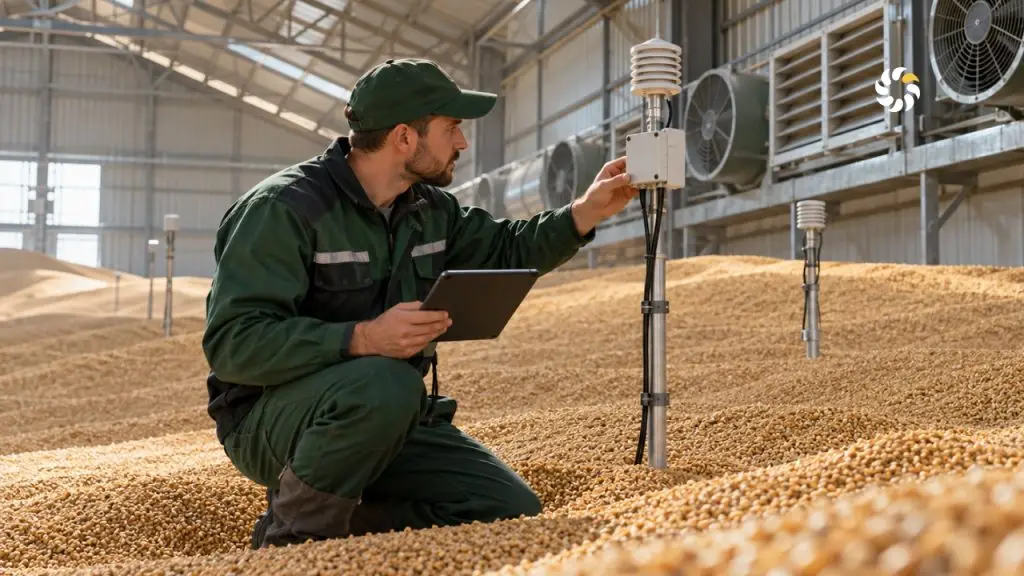
How to organize stock monitoring during winter?
Record the date, temperature, moisture, surface condition, odor, pests, ventilation operation, deviations, actions, and results in the log. Mark measurement points on a diagram.
Frequency depends on risk. High moisture, uneven temperature, or infestation require more frequent monitoring. The interval for stable stock is determined by the crop, weather, and storage duration.
The response algorithm consists of six steps:
- Record the change and the point of its detection.
- Repeat the measurement with a functioning device.
- Define the boundaries of the problem zone.
- Check possible causes.
- Select a corrective action for the specific batch.
- Monitor the result and enter the record into the log.
This procedure reduces the risk of late intervention and provides a history for the next season. Grain quality control covers product indicators, equipment health, and the accuracy of recorded operations.
How much can poorly organized grain storage cost?
The farm has already paid for seeds, fertilizers, crop protection products, fuel, field work, and harvesting. The warehouse holds the accumulated value of the harvest; therefore, financial consequences arise from physical weight loss, grade reduction, additional cleaning, drying, movement, pest control, repairs, or urgent sales.
A hypothetical stock of 1,000 t at an estimated value of 8,000 UAH/t:
1,000 t × 8,000 UAH = 8,000,000 UAH.
If we take physical losses at a level of 1% for illustration, their cost will be:
8,000,000 UAH × 1% = 80,000 UAH.
One percent in this example is not a standard or a forecast. The calculation shows the scale of risk against which the costs of cleaning, ventilation repair, thermometry, and inspections are compared. The final result for the crop also depends on post-harvest costs, which complements the crop cultivation economics.
How to include warehouse management in the winter budget?
The estimate includes facility repairs, ventilation, sensors, transport equipment, laboratory tests, cleaning, sanitary measures, electricity, personnel, spare parts, and a reserve for emergency work. Expenses are divided into mandatory before loading, operational during winter, and capital improvements.
Warehouse expenses are integrated with machinery repairs and resource procurement into the overall agribusiness financial planning. A monthly cash flow shows when payments for storage and preparation for the next season occur simultaneously. The approach to how to plan expenses for agro-resources helps to form base and reserve scenarios.
If the total load exceeds available working capital, first review the timing of non-critical expenses and supplier schedules. Additional options are described in the article on actions to take if there is not enough money for the sowing season. For expenses that need to be financed before expected revenues, you can evaluate financial solutions for agribusiness and compare terms with the payment calendar.

Checklist for preparing the warehouse for loading
Before loading, check the readiness of the premises, equipment, and control systems. The checklist will help you consistently go through the main stages and distribute responsibility for stock monitoring. Main preparation steps:
- clear the premises of residues from previous batches;
- perform mechanical cleaning;
- inspect the roof, walls, floor, and joints;
- eliminate leaks and check sealing;
- clean ventilation ducts and test fans;
- check thermometry, sensors, and the electrical grid;
- inspect bucket elevators, transporters, and screw conveyors;
- carry out planned sanitary measures;
- check rodent protection;
- prepare batch accounting and the placement scheme;
- check products before intake;
- assign those responsible for monitoring;
- create a log and a response algorithm;
- include expenses in the winter budget.
Work is completed before mass loading. After the products are placed, access to structures, ducts, and part of the transport equipment will be limited.
Preparing the warehouse facility covers the premises, equipment, product condition, batch placement, and monitoring. Early detection of leaks or heating reduces the risk of drying, movement, or loss of batch grade.
The work cycle includes auditing, cleaning, repairs, product control, batch identification, and responding to changes. It helps to preserve the harvest and plan winter expenses.