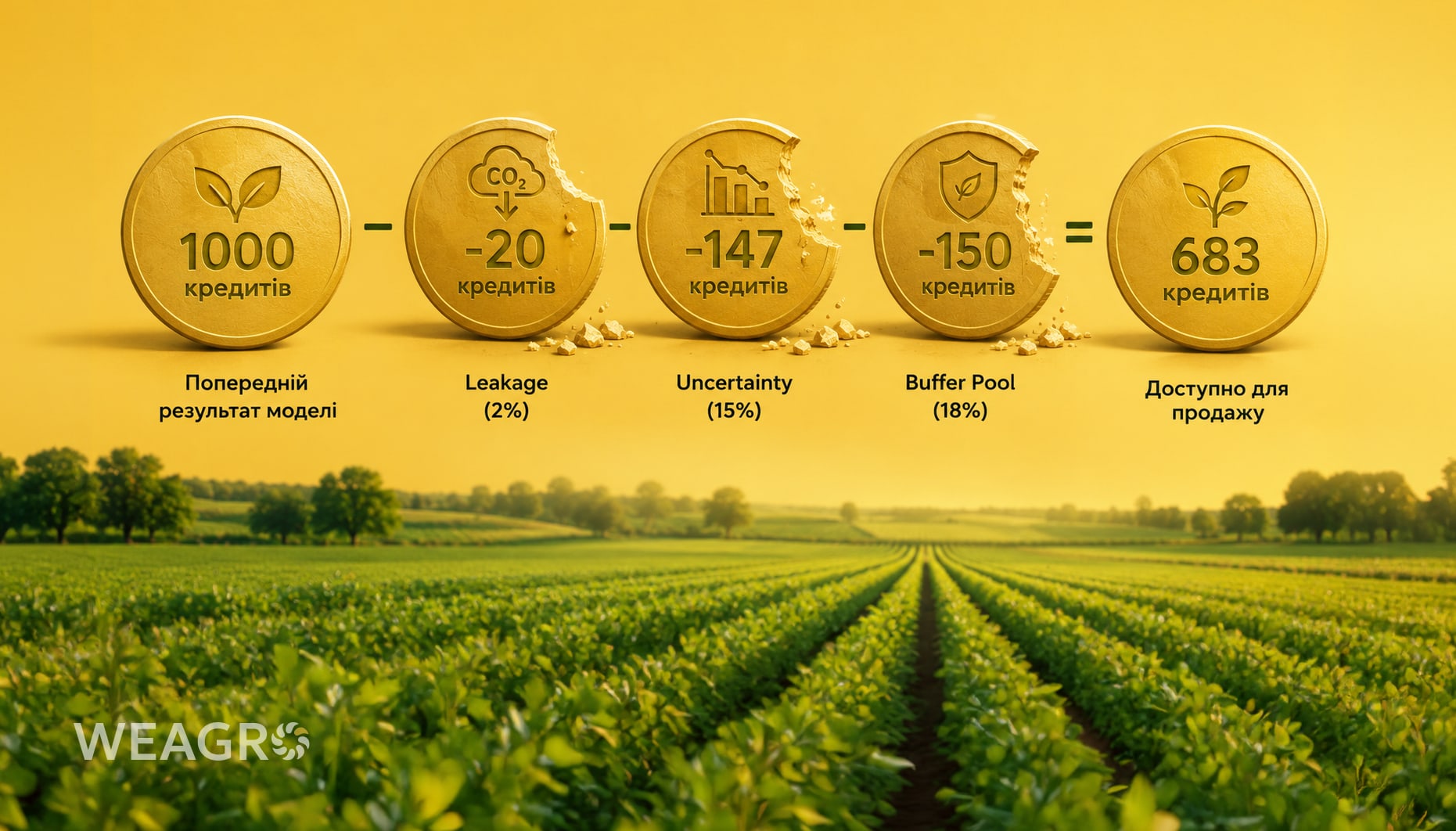
Imagine a simple scenario: a farmer transitions to no-till farming, leaves more residue in the field, plants cover crops, and the model shows that the farm can receive 1,000 carbon credits.
Sounds good. But in practice, these 1,000 tons of CO2 almost never convert into 1,000 credits in the registry.
Why is that? Because the model is only the initial calculation. The result then undergoes several checks and adjustments. And these determine how many credits the farmer will actually be able to receive.
From Model to Actual Carbon Credits
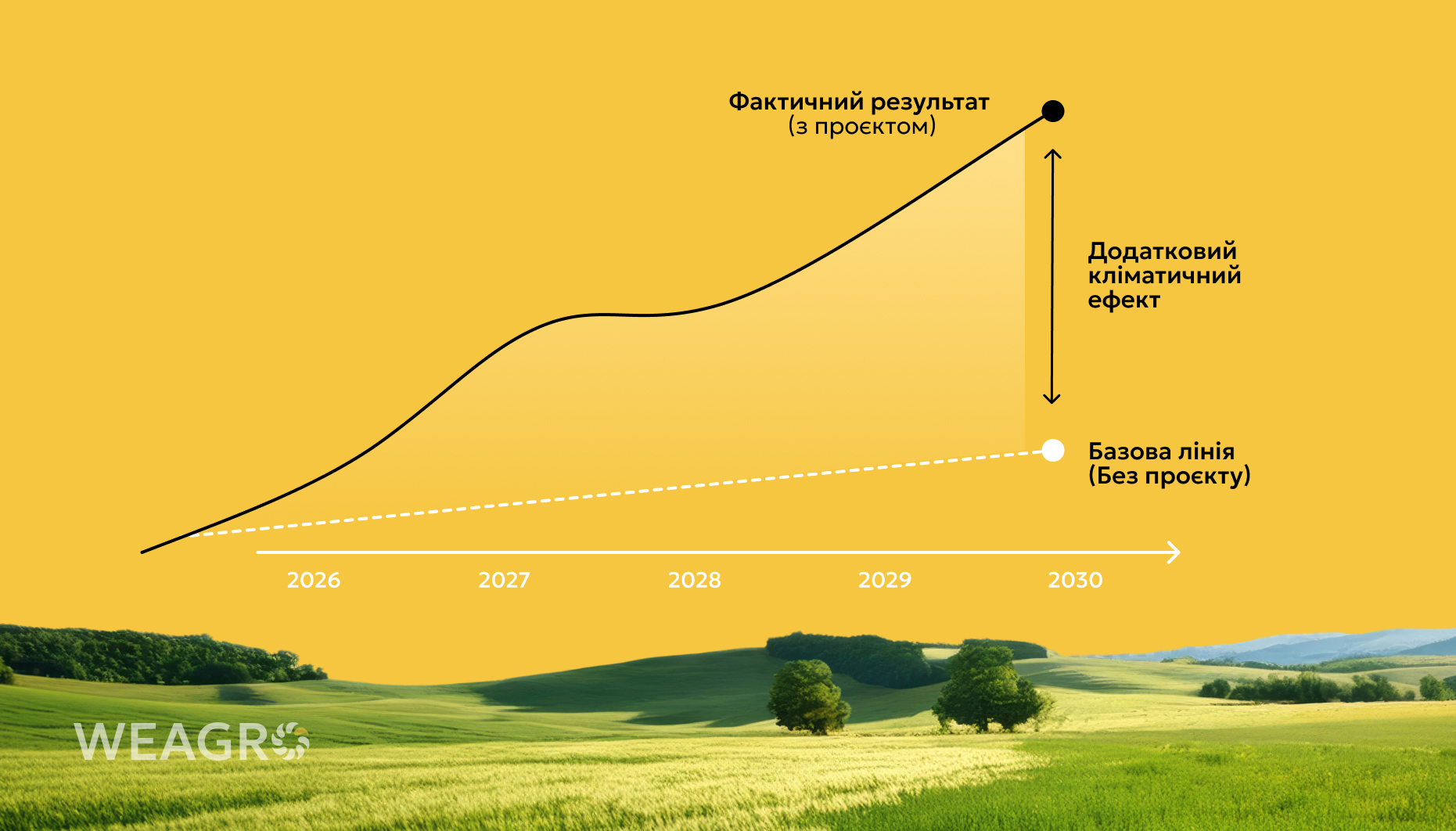
In the previous article, we examined in detail what a baseline is. In short, it shows what would have happened to carbon stocks even without the farm’s participation in the carbon project.
If you have not yet read this material, I recommend starting with it, because the baseline becomes the foundation for calculating the number of future carbon credits.
You can read it at this link: https://weagro.ua/blog/chomu-vugleczevi-kredyty-rahuyut-ne-vid-poperednogo-roku/
Today we will examine what happens after the model has already shown the preliminary result. What is subtracted from it? Why does the final number of credits turn out to be less than the initial calculation? And why this is not an error, but the normal logic of a quality carbon project.
To answer these questions, you need to understand only three key things:
1. Did the changes in the project fields lead to increased emissions elsewhere?
2. How much can the obtained calculations be trusted?
3. What is the risk that the accumulated carbon in the soil may be lost in subsequent years?
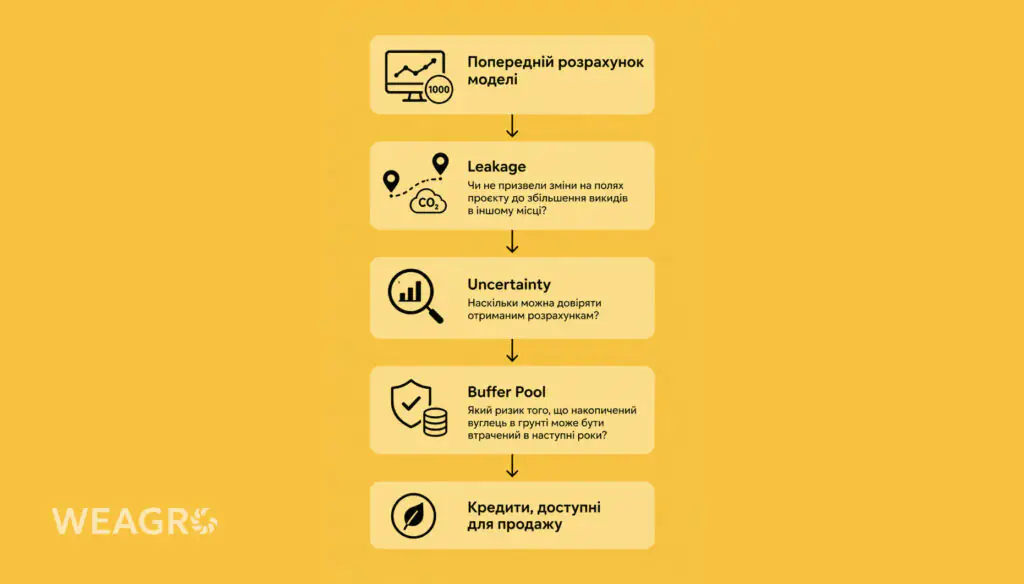
So let us examine at which stages and why the number of carbon credits may decrease.
Leakage (Emission Transfer)
In international standards, this is called Leakage—the transfer of emissions beyond the project boundaries.
Imagine that a farmer implemented new practices only on part of their fields that were included in the carbon program. Emissions on these fields did indeed decrease. But to compensate for the loss of yield or change in technology, they began to cultivate other fields more intensively or increased fertilizer use on areas not included in the project.
Or another example. A farmer began using more organic fertilizers, such as cow manure. Then the question arises: where did it come from? If manure production was increased for this purpose or additional emissions occurred during its acquisition or transportation, these emissions must also be accounted for.
And in such a case, a logical question arises: did the farm’s overall emissions actually decrease, or did they simply “move” to another location?
That is why standards assess the risk of Leakage before issuing carbon credits. If it turns out that part of the emission reduction was actually compensated outside the project, the corresponding number of credits will not be credited.
Fortunately, for most agricultural carbon projects, the risk of Leakage is small, so the impact of this indicator on the final number of credits is usually insignificant. In practice, for most agricultural carbon projects, Leakage can be zero or approximately 0–5% of the previously calculated number of credits.
For our example, let us imagine that Leakage was calculated at 2%. Then the scheme will look like this:
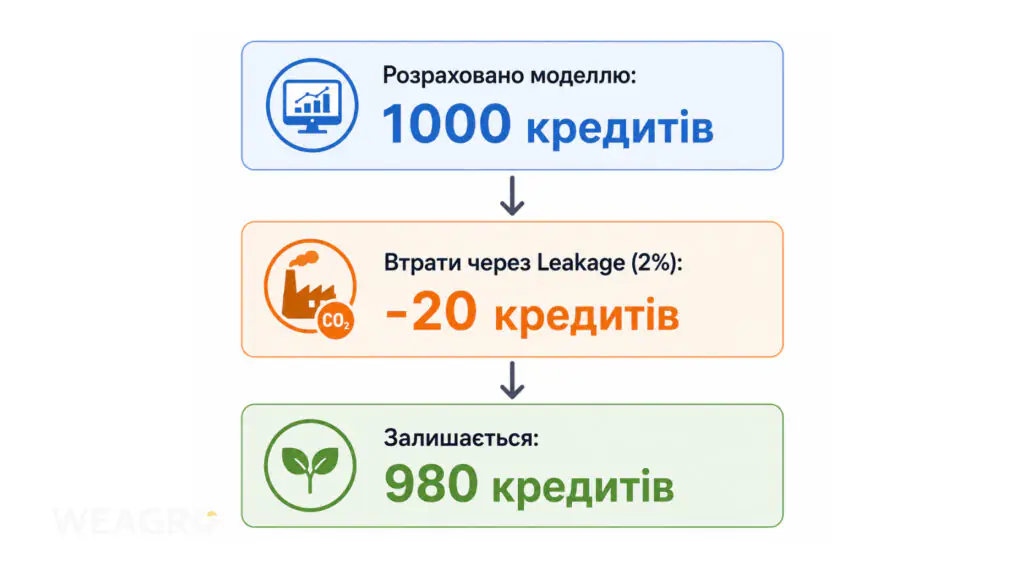
That is, Leakage is rarely the main cause of a large “minus.” The next stage—uncertainty in calculations—often has a much greater impact.
Uncertainty (Calculation Uncertainty)
Imagine that you want to determine the average wheat yield in a field of 100 hectares.
Is it sufficient to harvest from just one square meter for this purpose?
Of course not. After all, even in one field there are areas with different fertility or moisture.
With carbon stocks in the soil, the situation is even more complex. Unlike yield, organic carbon is very unevenly distributed in the soil. Even within one field, its content can differ significantly from point to point. And even if the model performed all calculations correctly, there is always some uncertainty.
That is why the Verra standard for carbon farming projects (VM0042) requires mandatory soil sampling before verification of results. At the same time, it does not establish a single rule for how many samples need to be taken or where they should be located. Instead, each project must justify its sampling system so that it ensures sufficient accuracy of calculations.
Simply put, the more heterogeneous the soils and the fewer samples taken, the higher the uncertainty of the results will be. And this can directly affect the number of carbon credits.
Because soil sampling is the most expensive component of most carbon projects, the project developer constantly has to find a balance between the cost of sampling and the future number of carbon credits.
If there are many samples, the level of uncertainty will be lower, and therefore the project will be able to receive more credits. However, an excessive number of samples can make monitoring so expensive that the additional costs exceed the income from the credits received.
If there are insufficient samples, uncertainty will increase, and with it the number of credits that will not be credited will also increase.
That is why it is worth the farmer asking how exactly soil sampling is organized in the project. If you are told that there will be a minimum of samples or they are not planned at all, it is worth asking a simple question: at the expense of what, then, is the necessary accuracy of calculations ensured? After all, lower costs for sampling often mean a smaller number of credits that will ultimately be issued.
To assess uncertainty, Verra uses a separate statistical approach based on mathematical calculations and probability theory. We will not delve into mathematical formulas in detail now, as this is the topic of a separate article. But soon we will examine in detail how exactly uncertainty is calculated, what it depends on, and how it can be reduced. After all, it is often this indicator that determines how many carbon credits will be lost even before their issuance.
In practice, the level of uncertainty can differ significantly from project to project. In some cases, it is only 1–2%, while in others it can reach 20% or more. Some projects even encounter values at the level of 30%, which leads to noticeable losses of carbon credits.
For our example, let us assume that after all calculations, the level of uncertainty was 15%. Then our scheme will gradually take on the following appearance:
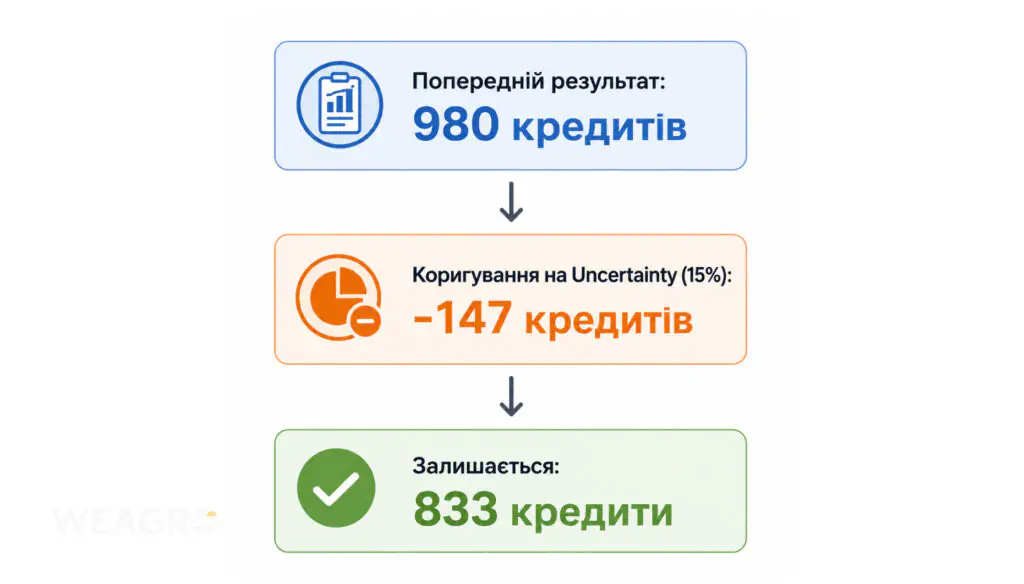
Sometimes a poorly constructed Sampling Design can cost a project more credits than several years of quality-implemented agricultural practices. That is why Sampling Design is one of the most important elements of any carbon project.
At this point, it may seem that all necessary adjustments have already been accounted for, and 833 credits is the final result. But there is one more important stage that many farmers do not even suspect.
Before the credits reach the project owner’s account, part of them will be automatically sent to a special insurance buffer—the Buffer Pool. And this applies to virtually every carbon project.

Buffer Pool (Insurance Reserve)
Imagine yourself in the place of a company that purchases carbon credits to offset its own CO₂ emissions.
It is not enough for them to know that today more organic carbon has accumulated in the soil. They want to be confident that this carbon will remain in the soil not for one, two, or even ten years, but for fifty or even a hundred years.
After all, if in a few years the farmer returns to intensive tillage or another event occurs that leads to the loss of accumulated carbon, it will return to the atmosphere. And then a logical question arises: who will be responsible for the carbon credits that have already been sold?
That is precisely why international standards created the Buffer Pool mechanism—a common insurance reserve.
When carbon credits are issued, a certain portion of them is automatically reserved in this fund. These credits are not sold and are not transferred to the project owner. They are reserved as an insurance reserve in case of loss of accumulated carbon in the future.
To ensure that risk assessment is the same for all projects, Verra developed a separate tool—the Non-Permanence Risk Tool. It contains a list of criteria by which the project developer consistently evaluates each risk factor.
During such an assessment, the following is analyzed, among other things:
- how long the project developer plans to conduct monitoring and control over the land plots;
- whether farmers have legal obligations to adhere to regenerative practices after receiving carbon credits;
- the risk that accumulated organic carbon may be lost due to a change in tillage technology;
- climate risks, such as prolonged droughts, floods, fires, or other extreme natural phenomena;
- political and regulatory risks that may affect project implementation;
- the availability of financial and organizational resources for long-term project support.
Based on the results of this assessment, the total number of points is calculated, which determines the percentage of carbon credits that will be reserved in the Buffer Pool.
In practice, the size of the Buffer Pool directly depends on how well the project developer can prove that the carbon accumulated in the soil will be preserved over a long period of time. This is precisely what is verified during the risk assessment and confirmed by documents that undergo verification by an independent auditor.
In practice, this indicator can differ significantly from project to project. Most often it is approximately 10–15%, but there are even projects in which this indicator is 24–30%.
For large grouped projects involving a large number of farmers, ensuring long-term adherence to uniform practices is much more difficult. That is why the assessed level of risk and, accordingly, the Buffer Pool may be higher.
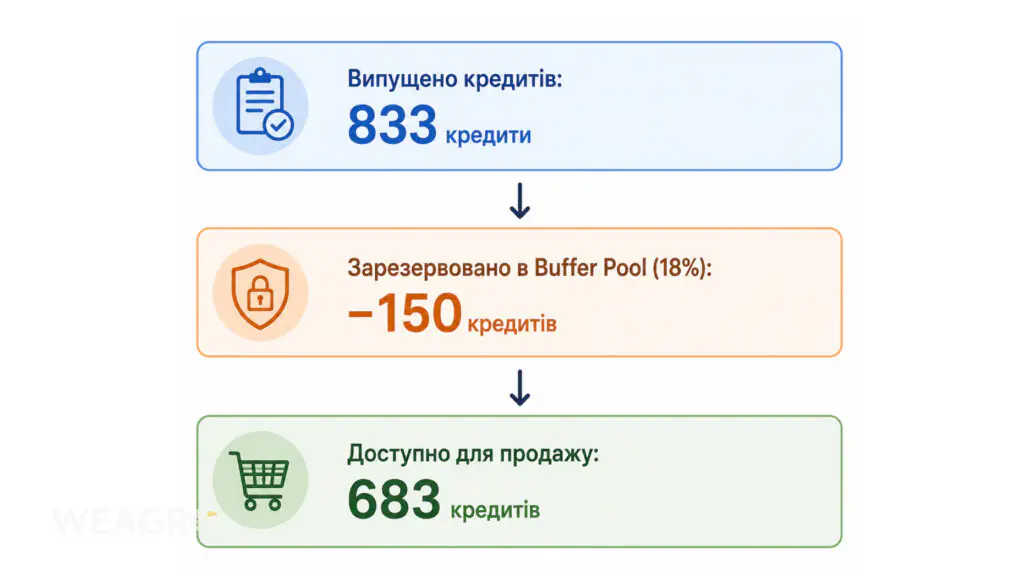
For our example, let us assume that based on the results of the risk assessment, the project received a Buffer Pool at the level of 18%. Then the final calculation will have the following appearance:
Conclusions
So, in our example, the model initially calculated 1,000 carbon credits, but after accounting for Leakage, Uncertainty, and Buffer Pool, only 683 credits remained for sale.
At the same time, it is important to understand that this example is conditional and deliberately built on rather conservative assumptions. In real life, a professionally developed carbon project can significantly reduce losses at each of these stages.
A quality baseline, a properly constructed Sampling Design, effective risk management, and competently prepared project documentation allow for a significantly larger number of carbon credits to be obtained.
That is why the preliminary calculation of the model should never be perceived as the number of credits that the farmer is guaranteed to receive. This is only a starting point. The final result depends not only on how effectively regenerative practices are implemented, but also on how professionally the carbon project itself is constructed.
In this article, we have already answered an important question: soil samples in carbon projects are necessary. Without them, it is difficult to prove the result and undergo quality verification.
But the next question immediately arises: where exactly to take these samples, when to do it, how many there should be.
What’s Next?
In the next article, we will examine in detail how Sampling Design is formed, what experts say about it, and what the farmer should pay attention to before entering a carbon project.
Together we are building a sustainable future for Ukraine’s agribusiness!