Many farmers believe that carbon credits are awarded because the amount of organic carbon in the soil has increased compared to the previous year. However, in practice, it is more complex. The main question is different. Did this improvement occur specifically because of the carbon project?
The Principle of “Additionality”
At the core of any carbon project lies the following principle: a credit can only be obtained for a result that would not have occurred without participation in the project.
For example, a farmer transitions to no-till, plants cover crops, and gradually increases the organic carbon content in the soil. The question arises: did this happen specifically because of the carbon project, or would the farm have implemented these changes even without the additional income from selling credits?
If the answer is the latter, then such a result is not considered additional and carbon credits are not awarded.
Imagine that the farm transitioned to the new technology several years ago due to rising fuel prices and a desire to reduce costs. Or such a practice is already common in the region. Or its implementation is directly required by legislation.
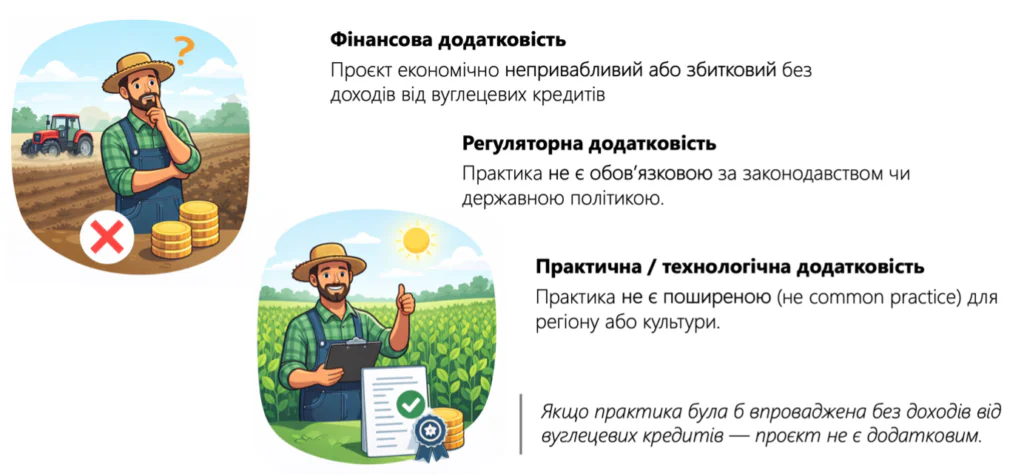
To put it simply, the logic is as follows: if the farmer would have implemented these changes even without income from carbon credits, then the project is not considered additional.
In such a case, international standards may conclude that the changes would have occurred regardless of the carbon project. Therefore, there are no grounds for awarding credits.
This is important for one simple reason. The buyer of a carbon credit is essentially paying for an additional climate result. They want to be confident that their funds truly caused positive changes, and not merely recorded a process that would have occurred anyway without their participation.
This is precisely why the principle of additionality is the foundation of all international carbon certification standards.
This is exactly how Verra formulates this logic in its rules:
“GHG emission reductions and removals must be additional to what would have occurred in a business-as-usual scenario.”
Verra. VCS Program Guide, v4.8, Section 4.1 (Project Requirements), Additionality Requirement.
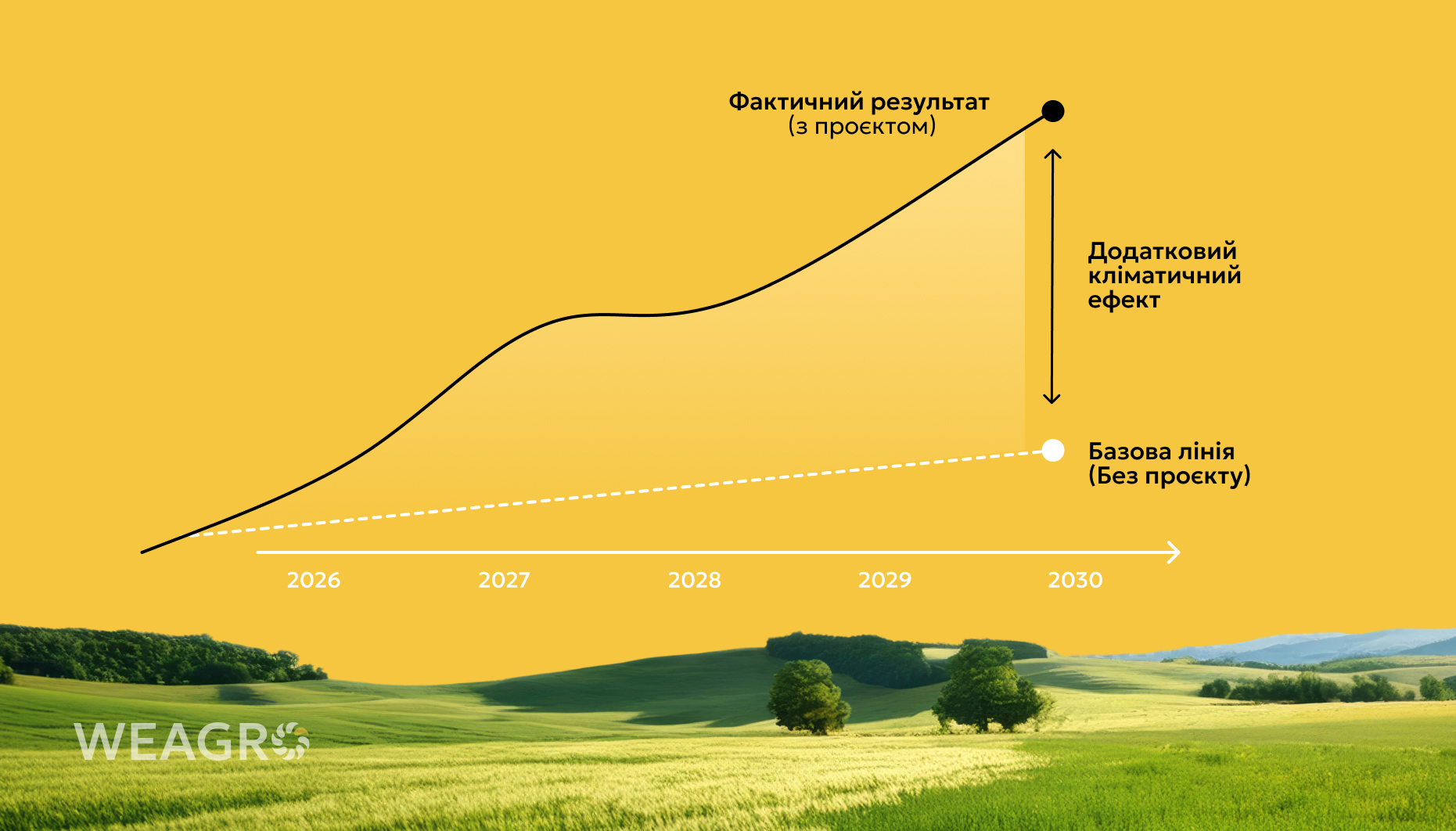
In other words, the standard directly requires comparing the project result not with the previous year, but with what would have occurred in the business-as-usual scenario without the project.

Baseline Scenario in a Carbon Project
However, a logical question arises: how can one practically prove that these changes would not have occurred on their own?
To do this, it is necessary to model an alternative scenario and answer the question of what would have happened to the field, soil, and organic carbon stocks if the farmer had not participated in the carbon project at all.
This hypothetical scenario is called the baseline scenario. It becomes the reference point for the subsequent calculation of carbon credits.
Baseline Scenario vs. Baseline
It is important to distinguish between two closely related concepts.
Baseline scenario – this is a description of the agricultural practices themselves: tillage, crop rotation, fertilizer application, yield.
Baseline – this is the quantitative result of this scenario, i.e., a forecast of changes in organic carbon stocks in the soil and associated greenhouse gas emissions. It is this calculation that affects the number of credits that can be issued. It is this indicator that is compared with the actual results in the corresponding year or period.
Therefore, it is incorrect to assume that carbon credits are awarded simply for the change in carbon stocks between the beginning and end of the project. In reality, the baseline and the actual result in the same year are compared.
How the Baseline Is Calculated
Two main approaches are used to calculate the baseline.
The first approach is field measurements. This requires having a control plot where new practices are not implemented, and regularly collecting soil samples from both the control and project fields. This approach is widely used in scientific research, but for large commercial projects it is expensive and difficult to organize.
Therefore, a more practical approach is modeling. In this case, a digital copy of the actual field is created. Historical management data is loaded into the model: crop rotation structure, yield, tillage, fertilizer application, as well as soil and climate characteristics.
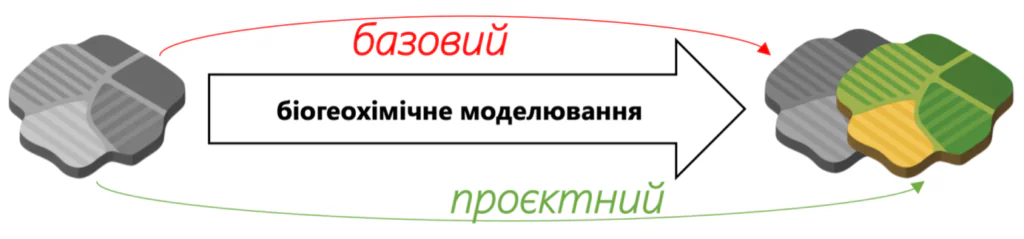
Typically, at least three previous years of data are used, but not less than one complete crop rotation cycle.
The longer and higher quality the data history, the more accurately the model can predict how the level of organic carbon would have changed without participation in the project.
Since it is physically impossible to measure the carbon content in the soil in a hypothetical scenario, biogeochemical models are used for such calculations. These are scientific mathematical algorithms that simulate the processes of accumulation and loss of organic carbon in the soil, taking into account climate, soil properties, and agricultural technologies.
It is these models that allow comparing two scenarios on the same field: what would have occurred without the project and what actually occurred after implementing new practices.
Two Practical Examples
Example 1. Changes Begin with the Project
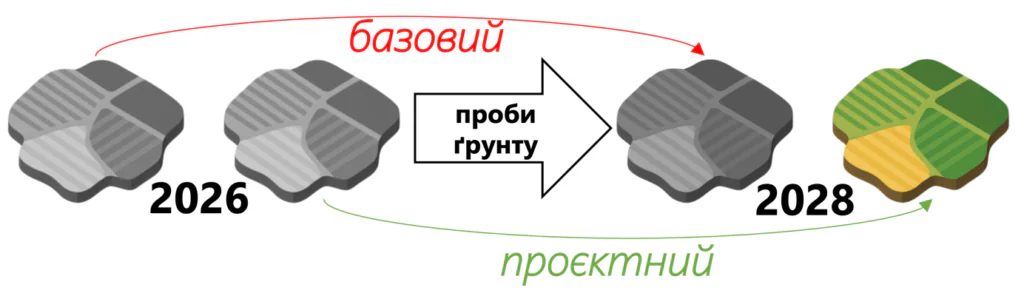
Suppose that until 2026 the farm used conventional tillage. In this case, the baseline scenario will also be built on traditional practices. The model may show that under such conditions, organic carbon stocks in the soil would gradually decrease.
After joining the project, the farm transitions to no-till and begins using cover crops. In the actual scenario, the model may already show an increase in organic carbon stocks.
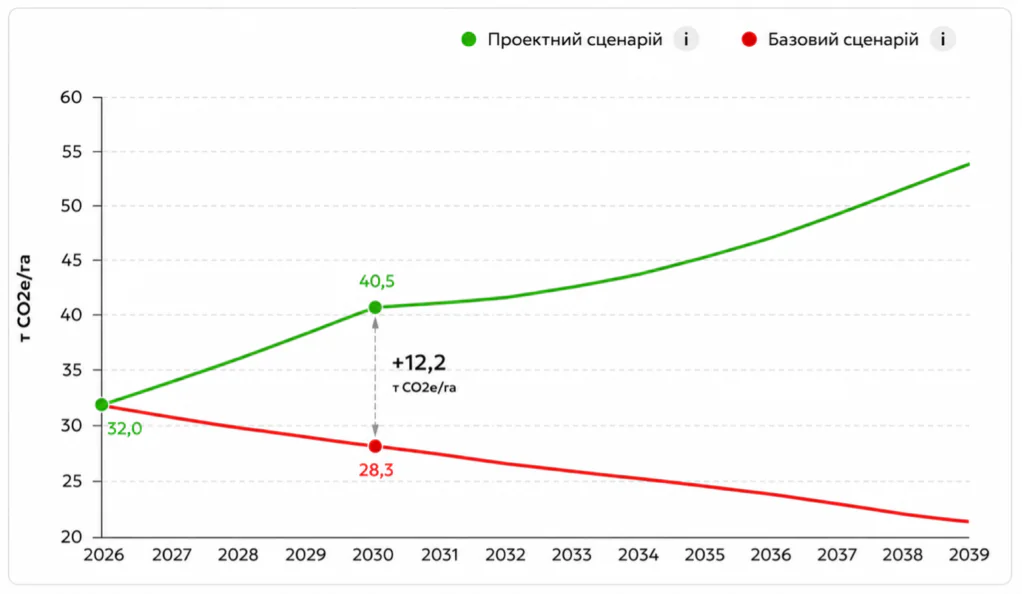
The difference between these two scenarios will be the additional climate effect for which carbon credits can be awarded. Therefore, a credit is formed not only because there is more carbon, but because of the difference between the actual scenario and the baseline.
Example 2. Practices Were Implemented Earlier
A different situation arises when the farm transitioned to no-till several years before participating in the project.
In this case, these practices are already included in the baseline scenario. This means that the model will predict the accumulation of organic carbon even without participation in the carbon project.
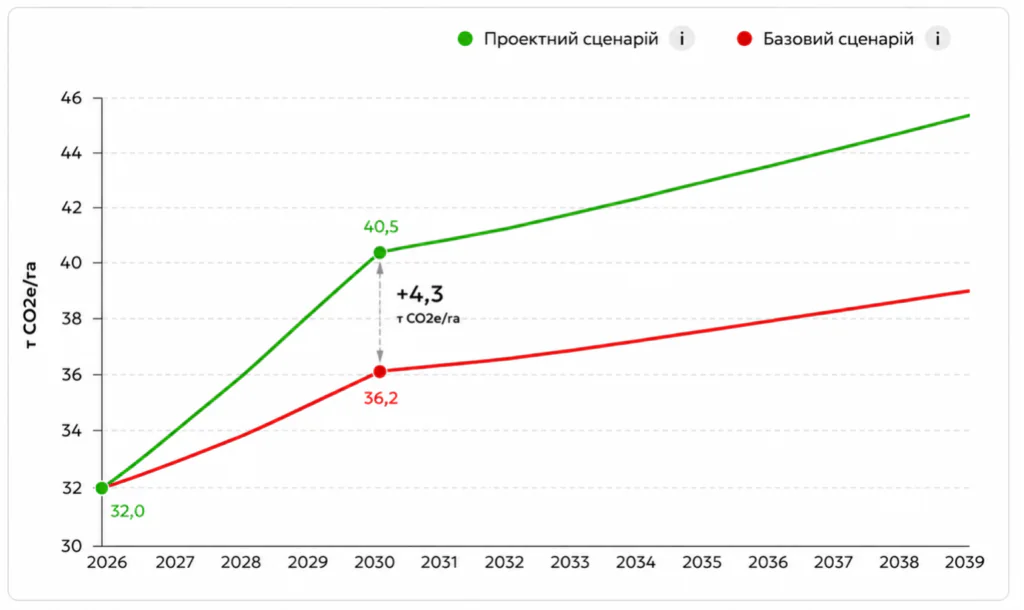
Therefore, this increase is not considered an additional climate effect. And if there is no additional effect, then there are no grounds for awarding carbon credits. However, the farm can create an additional effect through new practices that were not included in the baseline scenario.
This is precisely why carbon credits are awarded not for any accumulation of carbon in the soil, but only for the portion of the result that exceeds the baseline.
What’s Next?
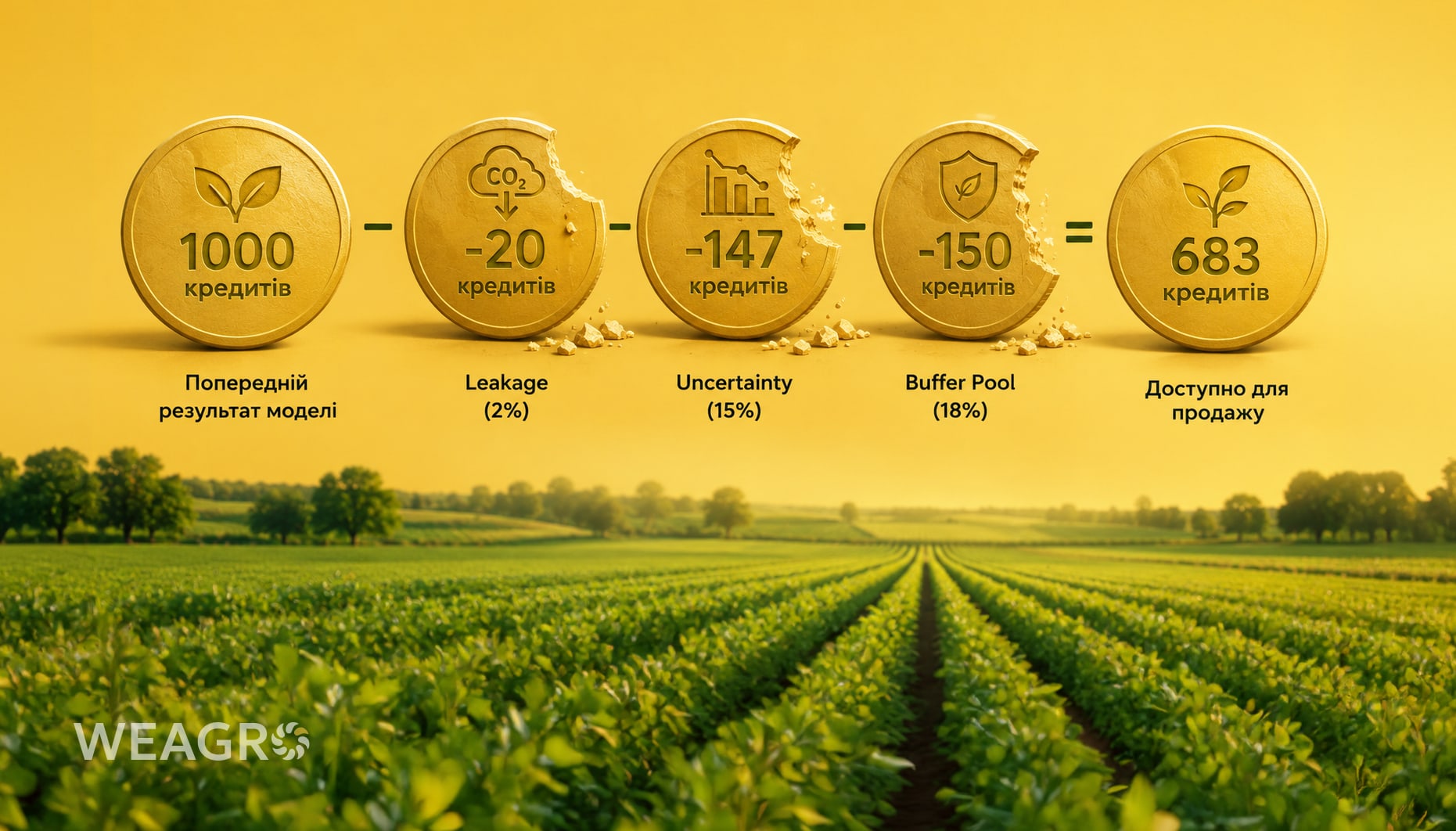
Even after determining the baseline, the calculation is not complete. In the next article, we will examine how special adjustment factors affect the final number of credits and why the actual volume of issuance is almost always less than the initial modeling result.
Together we are building a sustainable future for Ukraine’s agribusiness!